
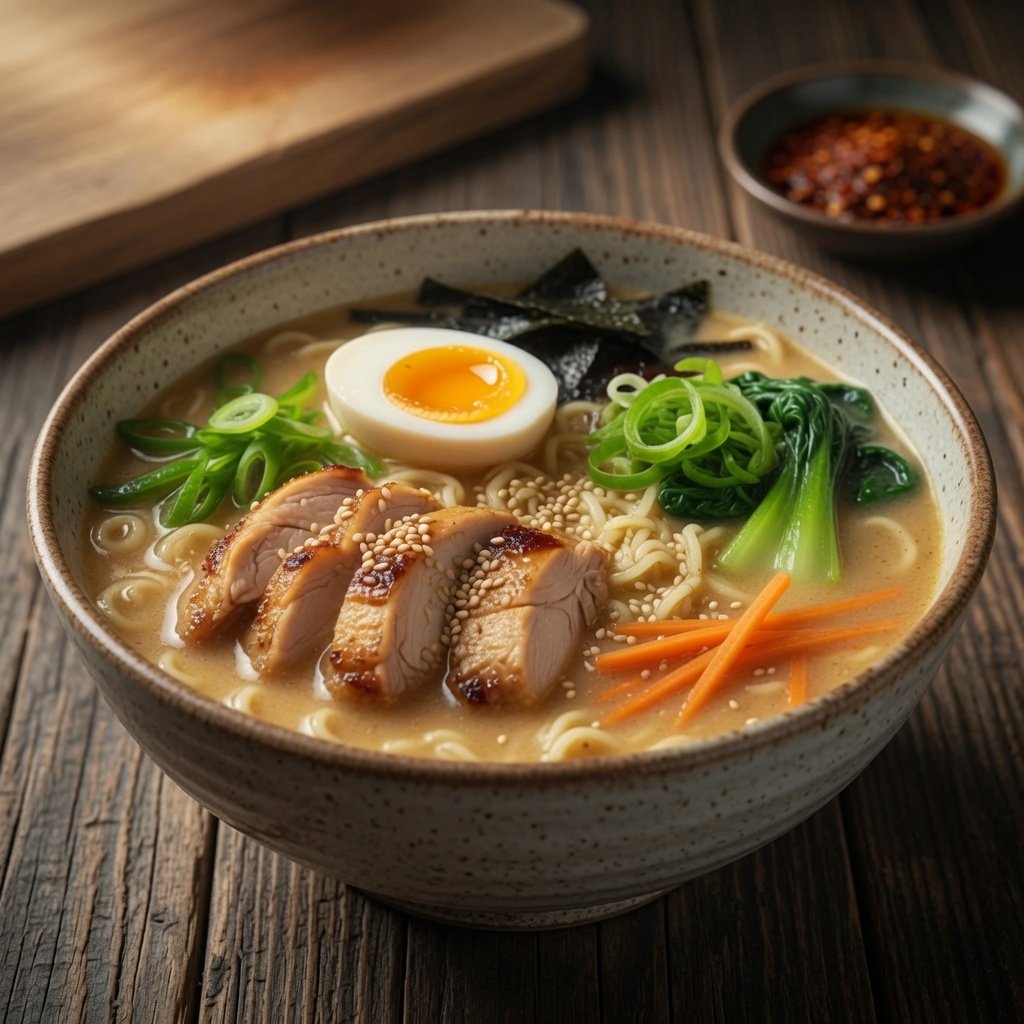
Ramen Original is the £8 bowl that quietly outsells almost everything else on our menu. Ramen, one fried egg, two slices of meat, sitting in a rich, savoury broth. No fireworks, no twenty toppings. It just works. This is how to build something very close to it at home in about half an hour.
The broth is white miso and chicken stock, which gives you that deep, rounded, slightly sweet savouriness that would normally take a day of simmering bones. The chicken poaches straight in the broth, so nothing is wasted and nothing is dry. The fried egg goes on last with a soft yolk that breaks into the soup. It is genuinely easy — if you can boil noodles and fry an egg, you can make this — and the only real skill is knowing when to stop.
This is a home recipe inspired by Ramen Original at The Cozy Bowl. It is not the restaurant’s exact commercial recipe.
Why this recipe works
- Thirty minutes, start to finish. The broth is built on shop-bought stock and miso rather than bones, so there is no long simmer and no skimming.
- Everything comes from a normal supermarket. White miso, dried ramen nests, pak choi and chicken thighs are all stocked by the big four, usually in the world food aisle.
- One pan does two jobs. The chicken poaches in the broth, which seasons the broth while it cooks and saves you washing up.
- The heat is entirely yours to set. The base is completely mild, so it works for children as it is, and takes chilli oil beautifully if you want it fierce.
- It gets better if you plan ahead. Make the broth the night before and a bowl of ramen becomes a ten-minute job after work.
Ingredient notes
White miso paste is the one that matters. Look for shiro or white miso rather than red — red is much saltier and more aggressive, and it will bully everything else in the bowl. It lives in the chiller cabinet or the world food aisle and keeps for months once opened. Three tablespoons for 1.2 litres of stock is a good starting ratio.
Chicken thighs, not breasts. Thigh meat stays tender when it sits in hot liquid; breast tightens and goes stringy. Boneless and skinless saves you a job.
The stock does a lot of the work. A fresh chilled stock or a good quality cube both work, but taste it before you build on it. If your stock is very salty, hold back the soy sauce until the very end.
Dried ramen nests are the easy option and are widely available now. Fresh or frozen ramen noodles are better if your local Asian supermarket carries them. What you want to avoid is fine egg noodles, which collapse in hot broth.
Crispy fried onions are the topping that makes it taste like ours. The tubs sold for salads are exactly right, and a bag lasts for ages.
If you would rather not lean on a shop-bought stock, our guide to building a clear chicken ramen broth walks through the whole process, and a batch of jammy soy marinated eggs is worth prepping the day before.
Substitutions and variations
Beef instead of chicken. This is closer to the beef version we serve. Freeze a piece of sirloin for 30 minutes, slice it as thinly as you can manage, then drop the slices into the hot broth for 30 to 60 seconds just before serving. Any longer and it goes grey and tough.
King prawns. Poach raw peeled prawns in the broth for 2 to 3 minutes, until they are pink and just firm. Faster than chicken, and lighter.
Meat-free. Swap the chicken for 300g firm tofu, pressed and pan-fried until golden, and use a vegetable stock. Check your miso, because some brands include fish stock — that will affect whether the finished dish is genuinely vegetarian, so read the label rather than assuming.
Creamier broth. Stir 100ml of unsweetened soy milk or coconut milk into the broth at the same time as the miso. It softens the salt and gives you something closer to our Sizzle and Silk heat level.
More heat. Chilli oil at the table is the flexible option because everyone sets their own level. If you want the heat built in, add half a teaspoon of chilli flakes with the garlic and ginger.
A note on the noodles. Swapping to rice noodles changes the texture considerably — they are softer and they break more easily — and they will also change the allergen picture, so check the packet.
Step-by-step guidance
The full method is in the recipe card below. These are the three points where it can go right or wrong.
Toasting the aromatics. Garlic and ginger go into hot sesame oil for about a minute, and you are looking for fragrance, not colour. The moment the garlic starts to turn golden it will keep cooking, and browned garlic turns the whole pot bitter. If in doubt, pour the stock in early.
Poaching, not boiling, the chicken. Keep the broth at a bare simmer with small bubbles around the edge of the pan. A rolling boil will make the thighs seize and squeak. Twelve to fourteen minutes is usually right; check by cutting into the thickest part, where there should be no pink and the juices should run clear.
Adding the miso off the heat. This is the step people skip and then wonder why their broth tastes flat. Take the pan off the hob, ladle a couple of tablespoons of hot broth into a small bowl, whisk the miso into that until it is completely smooth, then stir it back in. Miso that has boiled loses its aroma and can leave grainy specks through the soup.
Professional tips
Warm your bowls. Fill them with boiling water while the chicken poaches and tip it out at the last second. Ramen goes lukewarm fast in a cold bowl, and lukewarm ramen is a sad thing.
Cook the noodles in a separate pan, every time. Noodles release a lot of starch. Cook them in the broth and you get a cloudy, gluey soup and noodles that keep swelling in the bowl.
Season at the end, in small steps. Miso, soy sauce and stock are all salty. Build the broth, add the miso, then taste and adjust with soy a teaspoon at a time. You cannot take salt back out.
Get everything ready before the noodles go in. From the moment the noodles hit the water you have about five minutes. Slice your spring onions, have the toppings out and the bowls warm before you start.
Fry the eggs in a hot pan with enough oil. Spoon the hot oil over the whites as they set — that is what gives you the lacy, golden, slightly crisp edge rather than a pale rubbery one.
Serve it immediately. This is not a dish that waits. Assemble and carry it straight to the table.
Troubleshooting
| Problem | Likely cause | Solution | Prevention |
|---|---|---|---|
| Broth tastes flat or watery | Under-seasoned, or weak stock | Add light soy sauce a teaspoon at a time; a pinch of sugar rounds it off | Taste the stock before you build on it and choose a good one |
| Broth tastes bitter | The garlic browned | Hard to fix once done; a little sugar and extra miso will mask it | Cook garlic and ginger for one minute only, over a medium heat |
| Grainy specks through the broth | Miso added directly, or boiled | Strain the broth through a sieve | Whisk the miso into a ladleful of hot broth off the heat first |
| Noodles turned soft and bloated | Cooked in the broth, or sat too long | Nothing to be done once served | Cook separately, drain, and assemble at the last moment |
| Chicken is dry or squeaky | Broth was boiling, or chicken breast was used | Slice thinly across the grain to soften the texture | Use thighs and keep the broth at a gentle simmer |
| Fried egg yolk set hard | Pan too hot, or cooked too long | Serve anyway — still good, just less silky | Medium-high heat, 2 to 3 minutes, and pull it when the white is just set |
| Bowl goes cold quickly | Cold bowls | Reheat is not practical once assembled | Warm the bowls with boiling water first |
What to serve with it
A bowl of ramen and a sharing plate is how most of our tables order, and it works just as well at home. Crispy naga chilli sliced potatoes are the obvious partner — the heat and the crunch cut through a rich broth nicely. If you want something softer alongside, chicken bao buns with our creamy secret sauce turn this into a proper feast for four.
To drink, keep it cold and sharp rather than creamy. A lychee or mango cooler works far better against miso than anything milky. And if you are still hungry afterwards, something crisp and fruity like an apple pie roll is a better finish than heavy chocolate.
For more bowls built on the same broth, have a look through our ramen bowl recipes.
Storage and reheating
Store the parts separately. This is the whole trick. Broth in one container, chicken in another, and cook fresh noodles when you want to eat. Noodles stored in broth turn to mush overnight and cannot be rescued.
Cooling. Cool the broth quickly — a wide, shallow container helps — and get it into the fridge within two hours.
Fridge. Keep the broth and the cooked chicken covered in the fridge and use within two days, in line with standard UK food safety guidance. Reheat the broth until it is piping hot throughout, then take it off the heat before adding any extra miso.
Freezer. The broth freezes well, ideally before the miso goes in. Cooked chicken can be frozen but the texture softens noticeably. Do not freeze cooked noodles, pak choi or fried eggs.
What changes. Reheated broth is often slightly saltier as it reduces, so taste it and let it down with a splash of water or stock if needed.
Frequently asked questions
Can I make the broth in advance?
Yes, and it is the single best thing you can do for a weeknight. Make the broth without the miso, chill it, then reheat and finish with miso when you serve. Ten minutes from fridge to table.
What can I use instead of white miso?
There is no perfect substitute, because miso is doing the heavy lifting here. At a push, a tablespoon of light soy sauce plus a teaspoon of tahini gets you a savoury, slightly nutty broth, but it is a different dish. Red miso works if you halve the quantity.
Is this recipe spicy?
Not at all as written. It is closest to our Mellow Cuddle heat level, which is the one we recommend for children. The chilli oil is optional and served at the table so everyone chooses their own level.
Why cook the noodles in a separate pan?
Noodles release starch as they cook. In the broth, that starch makes the soup cloudy and thick, and the noodles carry on absorbing liquid in the bowl until they are soft. Separate pan, drained well, added at the last second.
Can I use instant ramen noodles?
Yes. Use the noodle block and throw away the flavour sachet, which will only fight your broth. Cook them for slightly less time than the packet says, because they will keep softening in the hot soup.
How do I get a soft-boiled egg instead of a fried one?
Lower fridge-cold eggs into boiling water and cook for exactly 6 minutes 30 seconds, then move them straight into cold water. Peel once cool and halve. The fried egg is what we plate on Ramen Original, but a jammy egg is just as good.
Can I double the recipe?
Yes, and the broth scales cleanly. Cook the noodles in batches, though, and do not crowd the pan — noodles need room to move or they clump.
Print
Miso Chicken Ramen with a Fried Egg
- Total Time30 minutes
- Yield2 bowls 1x
A 30-minute miso chicken ramen finished the way we plate Ramen Original at The Cozy Bowl: a soft fried egg and two slices of meat on top. Deep, savoury broth without the all-day simmer.
Ingredients
For the miso broth
- 1 tbsp toasted sesame oil
- 3 garlic cloves, finely grated
- 15g fresh ginger, finely grated
- 1.2 litres good chicken stock
- 1 tbsp light soy sauce
- 1 tsp caster sugar
- 3 tbsp white miso paste
For the chicken
- 400g boneless, skinless chicken thighs
- ½ tsp fine sea salt
For the bowls
- 2 nests dried ramen noodles (about 180g)
- 2 pak choi, halved lengthways
- 1 tbsp sunflower oil
- 2 large eggs
To finish
- 2 spring onions, finely sliced
- 1 tsp toasted sesame seeds
- 2 tbsp crispy fried onions
- Chilli oil, to taste (optional)
Instructions
Build the broth
- Heat the sesame oil in a large saucepan (3 litres or more) over a medium heat. Add the garlic and ginger and cook for about 1 minute, stirring, until fragrant but still pale. Browned garlic will make the whole broth bitter, so keep it moving.
- Pour in the chicken stock, add the soy sauce and sugar and bring to a gentle simmer. You want small bubbles around the edge of the pan, not a rolling boil.
Poach the chicken
- Season the chicken thighs with the salt and lower them into the simmering broth. Poach for 12 to 14 minutes, until a thigh cut open at its thickest point shows no pink and the juices run clear.
- Lift the chicken onto a board and rest for 3 minutes, then slice each thigh across the grain into four or five pieces. Keep the two best slices per bowl for the top.
Noodles, greens and egg
- Bring a separate pan of water to the boil and cook the ramen noodles for the time given on the packet, usually 3 to 4 minutes. They should be tender but still have some bite. Drain well and divide between two deep, warmed bowls. Cooking them apart from the broth keeps the broth clear and stops them going soft.
- Drop the pak choi into the simmering broth for 2 minutes, until the stems are just tender and the leaves have wilted, then lift out with a slotted spoon.
- Heat the sunflower oil in a frying pan over a medium-high heat and fry the eggs for 2 to 3 minutes, spooning a little of the hot oil over the whites. You are looking for lacy golden edges and a yolk that is still soft.
Finish and serve
- Take the broth off the heat. Ladle two tablespoons of it into a small bowl, whisk in the miso paste until completely smooth, then stir that mixture back into the pan. Do not let it boil again.
- Taste. The broth should be savoury, rounded and slightly sweet. If it tastes thin, add light soy sauce a teaspoon at a time until it lifts.
- Ladle the broth over the noodles. Top each bowl with two slices of chicken, the pak choi, a fried egg, spring onions, sesame seeds and crispy onions. Add chilli oil if you want heat. Eat straight away, while the noodles still have bite.
Notes
Make ahead. The broth is better made in advance. Cool it quickly, chill it within two hours and keep it covered in the fridge for up to two days, in line with standard UK food safety guidance. Reheat until piping hot, then stir the miso in off the heat at the very end.
The mistake to avoid. Boiling the miso. It flattens the flavour and can leave the broth grainy. Off the heat, whisked into a little liquid first, always.
A swap that works. Sliced beef instead of chicken, which is closer to the beef version of Ramen Original. Freeze a piece of sirloin for 30 minutes, slice it as thinly as you can and drop it into the hot broth for 30 to 60 seconds just before serving.
Equipment. A large saucepan of at least 3 litres, a second pan for the noodles, a frying pan for the eggs, a fine grater or microplane for the garlic and ginger, a slotted spoon, and two deep bowls warmed with hot water before serving.
Allergens. This recipe contains soya, wheat (gluten), egg and sesame. Some miso pastes and stocks also contain fish. Always check the label of every ingredient you use, as recipes and allergen information can change. People with food allergies or intolerances must also consider cross-contamination.
This is a home recipe inspired by Ramen Original at The Cozy Bowl. It is not the restaurant’s exact commercial recipe.
Come and let us make it for you
Making ramen at home is very satisfying right up until the washing up. If you would rather someone else built the bowl, Ramen Original is on our menu at 172 Biscot Road in Luton, along with seven other heat levels and a few bowls that are frankly ridiculous. Order for collection or delivery, or have a look at the full menu first.
If you make this at home, use the star rating on the recipe card to tell us how it went. We read every one.
More from our kitchen: if you want the same broth with more on top, try our dumpling ramen bowl with chilli oil or the punchier chilli oil beef ramen. To finish, mango and sticky rice Dream Rolls.
Newer From Our Kitchen
If you want to go deeper on ramen, our homemade ramen broth is the base this bowl really wants, and a batch of soy marinated ramen eggs will improve every bowl you make for the next few days. For a plainer version of the same idea, try our simple chicken ramen with a fried egg.